Paris, France · QA Automation & GenAI Testing · ISTQB Instructor · Open to opportunities

Ghassen
Azouz

I’ve spent five years building test infrastructure in banking, retail, online betting and telecom. These days I test LLM features, and I build AI agents to handle the repetitive parts of QA.

PlaywrightTypeScriptGenAI / LLM TestingAI AgentsBDD / CucumberCI/CDISTQB CTFL5+ yrs exp.
Based
Paris, FR
Status
Open to work
Certified
ISTQB CTFL
Languages
FR · EN · AR

QA Engineer.
I prevent bugs
before they reach your users.

I got into QA by accident and stayed because I liked it. Five years in banking, retail, online betting and telecom showed me that automation without a strategy mostly turns into expensive maintenance. So I treat test infrastructure like a product: someone owns it, its results can be measured, and a test that passes without protecting anything doesn't stay in the suite. These days I bring the same habits to GenAI. I test LLM features for hallucinations, safety issues and regressions, and I build AI agents to take the repetitive parts of QA off my plate.

How I work

  1. I start with the problem. Automation comes once I understand it.
  2. I write feature files that someone non-technical can read and sign off.
  3. I measure quality as a rate across the suite. One lucky green run proves nothing.

What I don't do

  • Decorative QA. If a test protects nothing the business cares about, I’ll tell you.
  • Claim I’ve mastered something I only know at 30%.
  • Pitch automation as the fix before I understand the problem.
5+
Years of Experience
4
Industries
44%
Faster pipeline: 40 min saved per run, 3 runs a day
1200+
API tests automated
3
Automation Frameworks mastered

Experience

(05)
  1. Jun 2026 — PresentParis, France

    QA Automation Engineer

    Telecom operator · multi-team cloud platform

    • I own the integration test strategy for 7 product units (infrastructure, networking, IAM, observability), including the entry criteria for API contracts and non-functional requirements.
    • I’m rolling out a Playwright framework on a 4-stage, multi-project GitLab CI pipeline. The aim is for the integration team to replay the tests of all 7 teams in a single build-once, promote-many flow.
    • I wrote the test strategy for the whole platform: coverage, tooling, automation standards and reporting.
    PlaywrightTypeScriptGitLab CIAPI testingMulti-project CI/CD
  2. Jan 2026 — May 2026Paris, France

    QA Platform Engineer · Freelance

    Real-time online betting platform

    • Owned the Playwright test infrastructure of a high-availability betting platform, shared by several product teams.
    • Split the E2E suite across 4 GitLab CI agents. A run went from 90 to 50 minutes (−44%), so developers got their feedback almost twice as fast.
    • Built quality dashboards for 2 QA teams working in SAFe, and trained both teams on CI/CD.
    PlaywrightTypeScriptGitLab CISAFe
  3. Jan 2024 — Dec 2025Massy, France

    QA Automation Engineer

    Major retail group · e-invoicing (XML/UBL)

    • Automated 1,200+ API test cases with Karate. Manual regression time dropped by about 70%, and the suite caught 80+ defects before they reached production.
    • Ran Gatling performance tests on the e-invoicing module. The fixes that came out of them made it respond 3× faster.
    • Maintained 200+ Selenium/Cucumber UI tests covering 85% of the regression scope. No regression made it to production.
    KarateGatlingSeleniumCucumberKafkaJenkinsGCP
  4. Jun 2023 — Sep 2023Tunis, Tunisia

    ISTQB Instructor · Part-time

    Tech training school

    • Taught ISTQB CTFL courses to junior QA engineers and to people moving into QA from other jobs.
    • Coached 20+ trainees through exam prep. Every one of them passed the CTFL.
    ISTQB CTFLTest designMentoring
  5. Jun 2021 — Dec 2023Tunis, Tunisia

    QA Automation Engineer

    Banking software vendor · loan origination

    • Wrote 150+ automated regression tests covering 60% of the core lending flows.
    • Brought the post-deployment regression cycle down from 4 days to under 4 hours.
    • Looked after the SQL Server test data, mocks and stubs on 3 environments.
    Katalon StudioSQL ServerPostmanJira

Projects

(05)
  • LLM Testing & Evaluation Framework — Learning Project (2026)

    GoalI wanted to test LLM-based apps as seriously as any other system, and it’s harder than it sounds. The output changes from one run to the next, "correct" is a property rather than an exact value, and a model upgrade can change behaviour without anyone touching the code. Classic API assertions won’t catch hallucinations, instruction drift, over-refusal or prompt injection.
    DecisionI used Playwright Test as a runner and left the browser out of it: fixtures for dependency injection, tags to choose what runs, and a custom reporter that makes decisions about the whole suite. Deterministic assertions run first, then heuristics, and the LLM judge comes last and fails closed. Retries are set to 0, because retrying until green hides the very non-determinism I’m trying to measure.
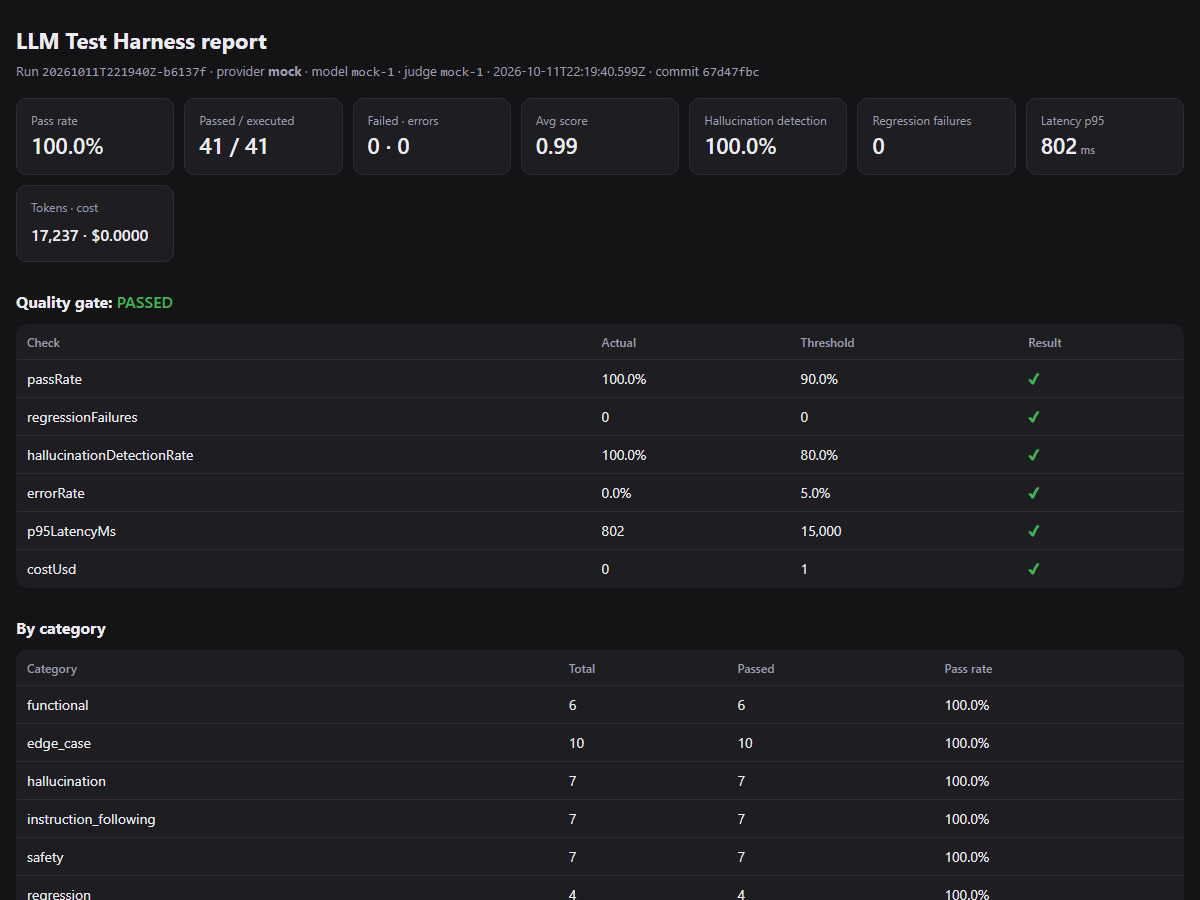
    Built41 YAML test cases in 6 categories (functional, edge case, hallucination, instruction following, safety, regression), validated with Zod. 13 evaluators, an OpenAI-compatible provider with a record/replay mock, and metrics for pass rate, p95 latency, tokens, cost and hallucination detection rate. Reports come out as JSON, HTML and Markdown, and a quality gate runs in CI. Strict TypeScript, 175 unit tests, 99% coverage.
    LearnedYou measure LLM quality as a rate across a whole suite. One pass or one fail tells you very little. Infrastructure errors have to be counted apart from model failures, and the LLM judge is non-deterministic too, so it needs guards of its own.

    OpinionTesting an LLM is still testing. You need data, layered assertions, metrics and a gate. What’s hard is not letting a lucky pass hide a model that hallucinates one time in three.

    LLM Test Harness
    Playwright TestTypeScriptLLM-as-a-JudgeZodYAMLGitHub Actions
  • Autonomous QA Agent for Claude Code — Learning Project (2026)

    GoalA lot of QA work is repetitive: turning a story into test cases, filing a bug someone can reproduce, figuring out why a pipeline went red, checking a fix, making the go/no-go call. I wanted to see how much of that an AI agent could take on, with a person still checking everything it produces.
    DecisionIt’s a Claude Code plugin with one skill per workflow, so only the mode you trigger gets loaded. It writes real Playwright + playwright-bdd tests that you can run, rather than describing them. The issue tracker sits behind a neutral contract, so the same workflows work on GitLab, GitHub, Jira, Azure DevOps or Bitbucket.
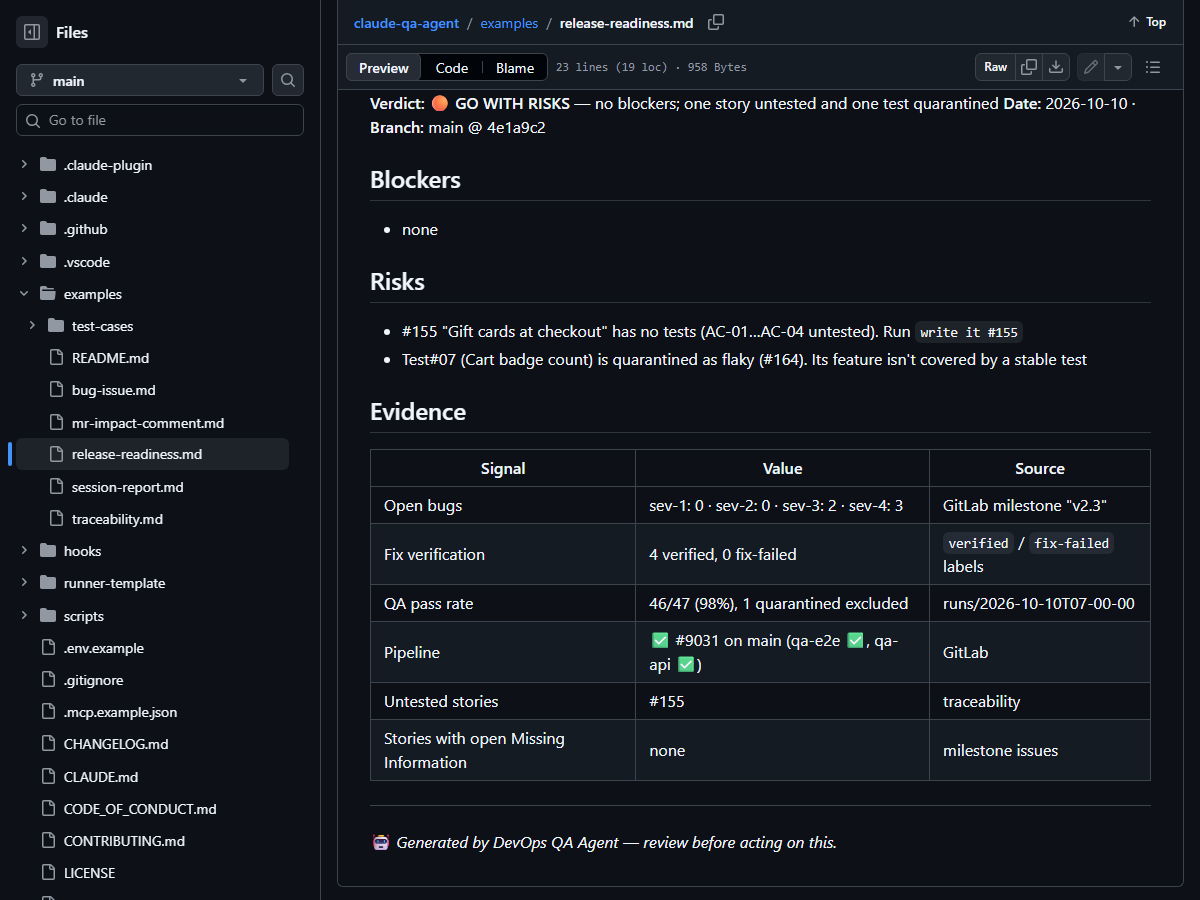
    BuiltSixteen modes, among them E2E sessions with axe accessibility checks, OpenAPI testing, bug filing, fix verification, CI failure diagnosis, MR test impact, flaky-test triage, a traceability matrix, k6 load tests, selector healing and release readiness. Everything it generates is marked as AI-generated, and CI runs the templates against a demo app to make sure they still work.
    LearnedMost of designing an agent is deciding what goes into its context, and several small, focused skills worked much better than one big prompt. Generated files also have to run and be clearly labelled. If they aren’t, nobody can review them or trust them.

    OpinionThe agent doesn’t replace a QA engineer. It handles the paperwork, and everything it writes is labelled so someone reviews it before acting on it.

    Claude QA Agent
    Claude CodePlaywrightplaywright-bddaxe-corek6GitLab CIMCP
  • Testify — QA Automation Practice Platform — Learning Project (2026)

    GoalI wanted to build and ship a complete learning product in my own field. The idea was to take real situations I’d run into in QA and turn them into exercises that get harder step by step, so other engineers can practise on them.
    DecisionThe front end is React + Vite on Vercel, and Supabase handles the database, auth, storage and server-side functions. Exercises are stored as data, with acceptance criteria and hints that unlock one by one, so adding content doesn’t need a code change.
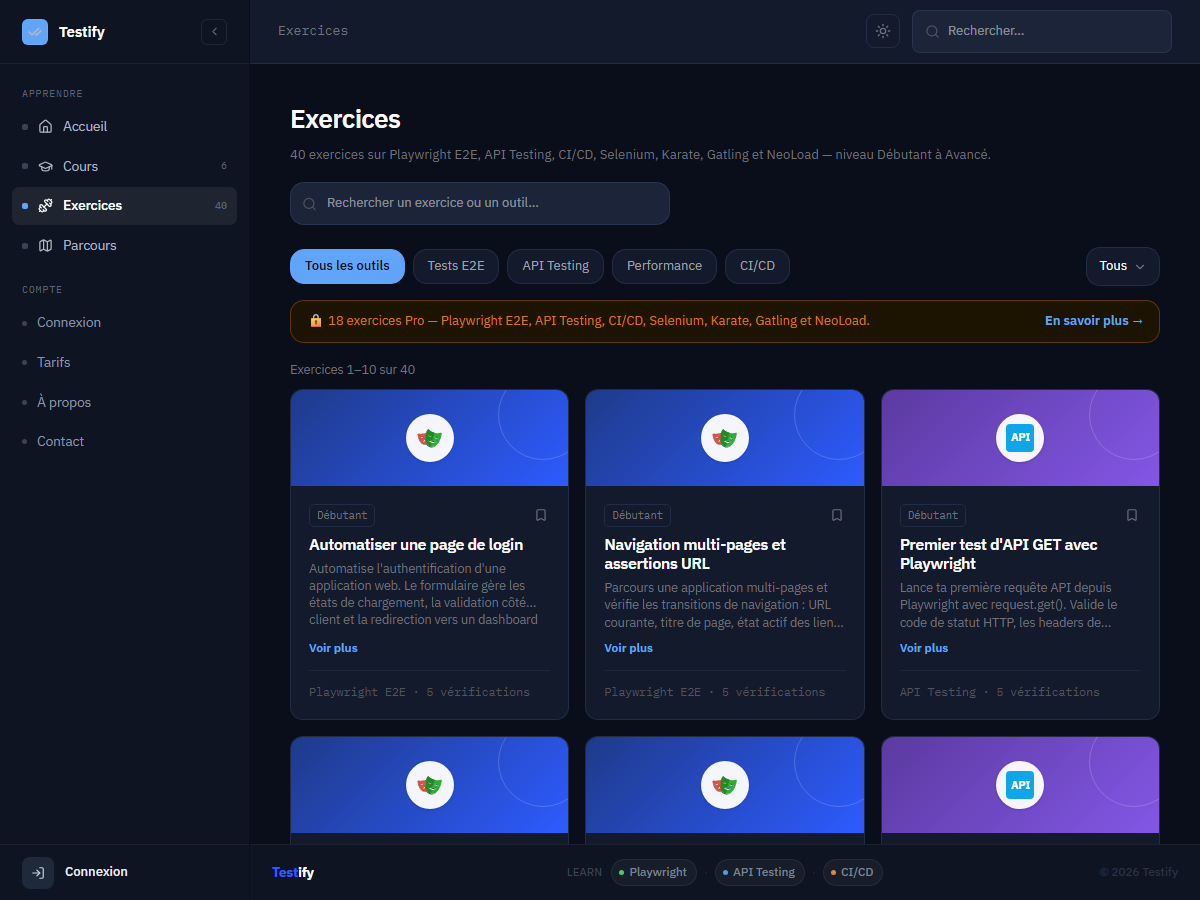
    Built40 exercises from beginner to advanced and 6 courses covering Playwright, Selenium, Karate, Postman, Gatling, NeoLoad and CI/CD. There’s progress tracking, a streak calendar, bookmarks, solution submissions, AI hints, PDF certificates and a Pro tier with Stripe checkout. Server-side functions run the code people submit, along with the Playwright checks.
    LearnedWriting a good exercise turned out to be test design in reverse. You need clear acceptance criteria, hints that point the way without giving the answer away, and checks that verify the behaviour instead of one particular implementation.

    OpinionEvery exercise is based on something I really had to test at work. Turning it into a lesson made me explain why we do things that way, and not only how.

    Testify
    ReactTypeScriptSupabasePlaywrightStripeVercel
  • Boussole — Personal Finance Web App — Learning Project (2026)

    GoalI wanted to build a complete product with quality in mind from the first commit. I started from a personal-finance spreadsheet, and the web app had to give the same numbers as the Excel file, down to the cent.
    DecisionThe simulation engine is pure: no framework, no clock, no randomness. A lint rule enforces that, so the engine can be tested on its own. Money is stored as integer cents and rounded the way Excel rounds. Supabase runs with Row Level Security on every table, and the browser only ever gets the publishable key.
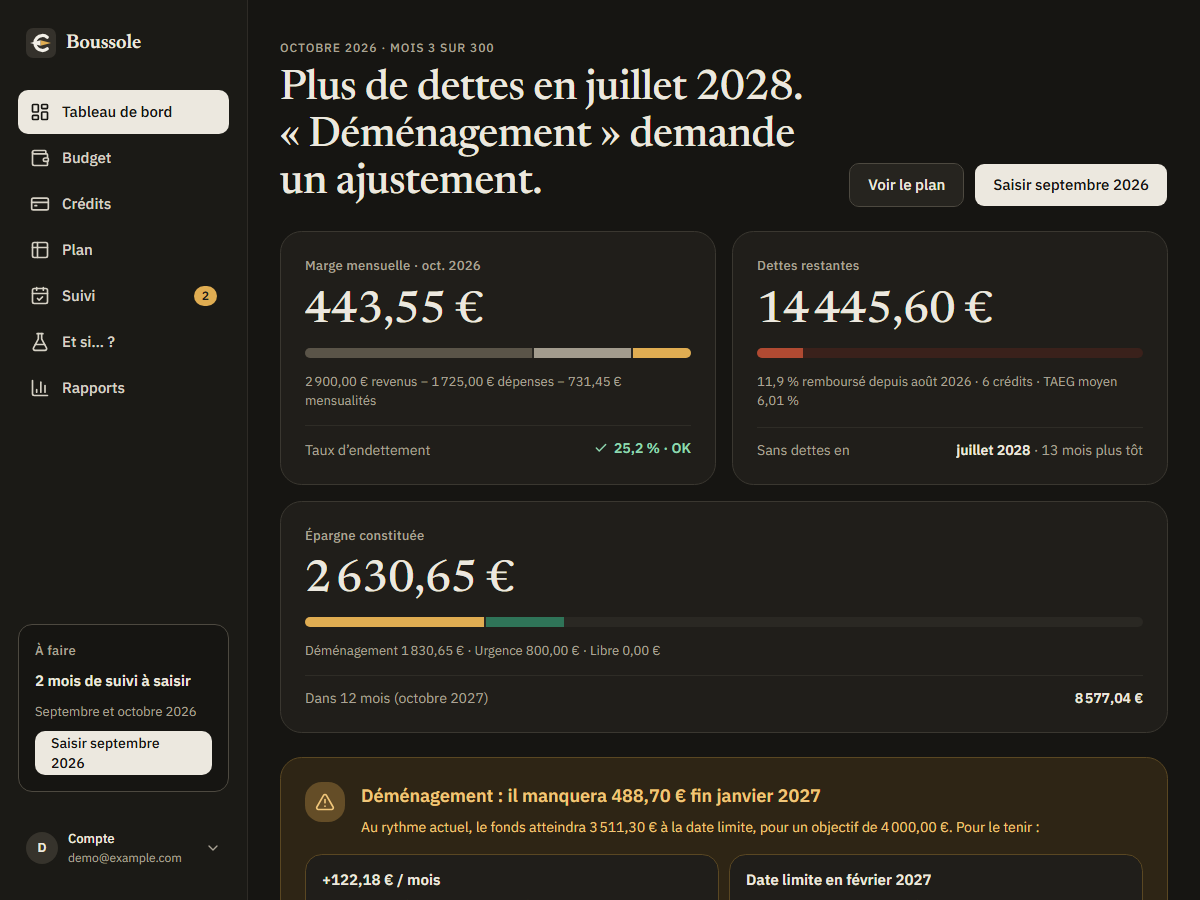
    BuiltBudget, loans, a 300-month repayment and savings plan, monthly check-ins against that plan, a "what if" simulator, JSON/CSV export and Excel import, light and dark themes, and you can install it on a phone. Around 920 tests back it up: the engine is checked against golden data computed by Excel across 16 scenarios, plus component tests, RLS isolation tests and Playwright journeys on desktop and at 375 px. All of it runs in GitHub Actions.
    LearnedReference data taken straight from the source of truth makes a very reliable oracle. Keeping the business logic pure made it cheap to test thoroughly. And security rules like RLS need tests of their own; writing the policy isn’t enough.

    OpinionThe tests check the app against the spreadsheet, not against my own code. If the two disagree by a single cent, the build fails.

    Boussole Finance App
    Next.jsTypeScriptSupabasePlaywrightVitestGitHub Actions
  • Playwright BDD Starter Framework — Learning Project

    GoalI wanted to set up Playwright with Gherkin in TypeScript from scratch: connecting feature files to step definitions, organising page objects, handling environments and running the suite in CI.
    DecisionI picked playwright-bdd because it compiles Gherkin into Playwright tests, so the runner, fixtures and reports are still Playwright’s own. Page objects keep the suite easy to maintain, and dotenv keeps credentials and URLs out of the code.
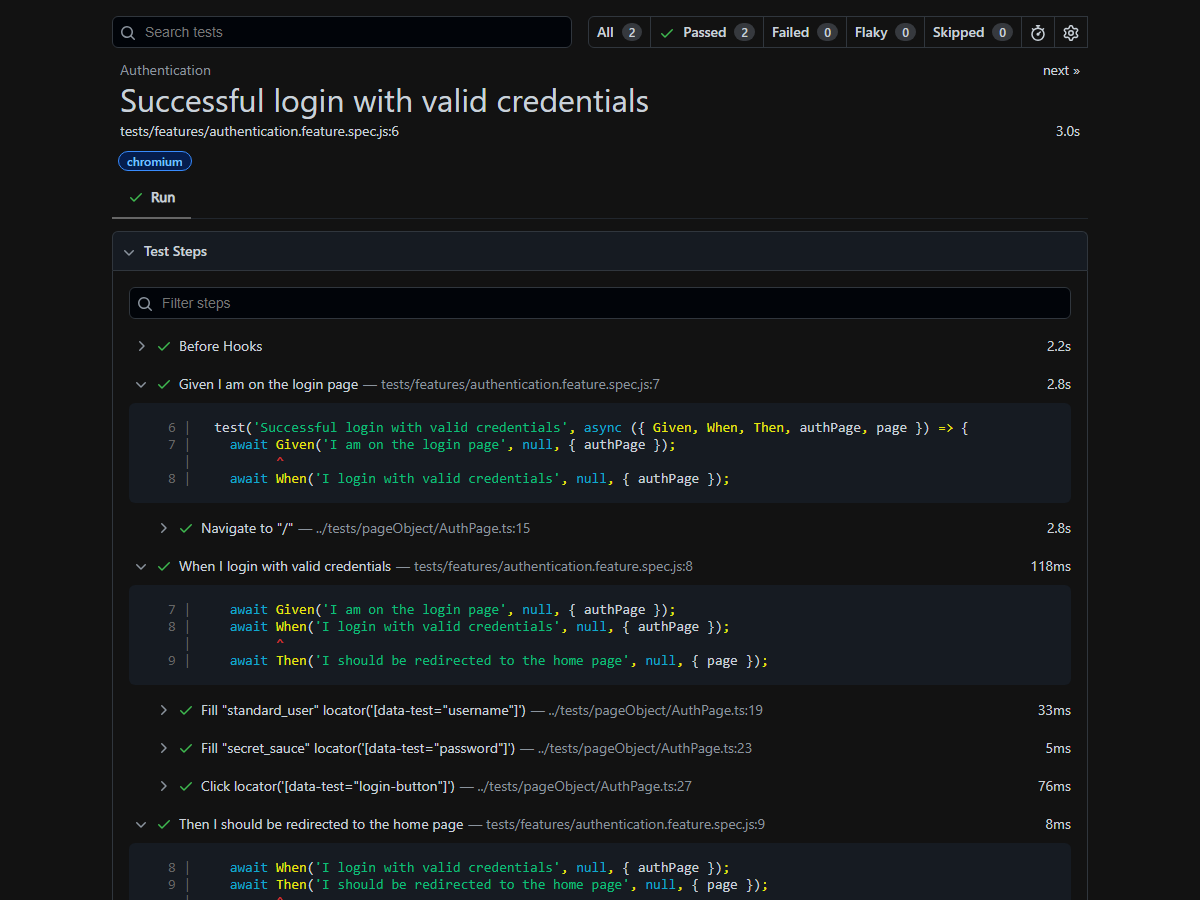
    BuiltAn authentication feature with valid and invalid login scenarios against SauceDemo, page objects that share a base page, a custom fixture that injects them into the steps, Playwright HTML reports and a GitHub Actions workflow.
    LearnedFixtures are the cleanest way to share page objects between steps. With secrets and URLs in environment config, the same suite runs unchanged in any environment.

    OpinionI’d rather have a small, clean base than a big one. I can explain and reuse every part of it.

    Playwright BDD Starter
    PlaywrightTypeScriptplaywright-bddGitHub ActionsPage Object Model

Skills

GenAI & AI Testing

  • LLM evaluation (LLM-as-a-judge)
  • Hallucination & safety testing
  • AI agents (Claude Code, MCP)
  • Prompt-injection testing

E2E & UI Testing

  • Playwright / TypeScript
  • Selenium WebDriver

API & Performance

  • Karate (API Automation Testing)
  • Postman (API Testing)
  • Swagger (API documentation)
  • Gatling (Performance)

Test Design

  • BDD / Cucumber / Gherkin
  • Page Object Model

CI/CD & DevOps

  • Jenkins / GitLab CI
  • Git / Versioning
  • Azure DevOps
  • Google Cloud Platform

Test Management & Languages

  • Jira / Xray
  • Java / Bash
  • TypeScript
  • SQL - PL/SQL

Certifications

  • ISTQB® Certified Tester — Foundation Level

    Syllabus 2018 · GASQ Service GmbH · No. 99003 ·

    I went on to teach the CTFL syllabus to 20+ trainees. All of them passed.

    View certificate

Languages

FrenchC1
EnglishC1
ArabicNative

Writing

(03)

Open to opportunities

CDI or freelance · Remote or hybrid in Paris

Let’s make
your next release
boring.

Contact me